


The midrash states that Yosef's brothers felt threatened by his favored status in Ya'akov's heart. They felt that Yosef and Ya'akov planned for Yosef's continuation of the Godly mission passed from Avraham to Yitzchak, excluding Yishmael, and from Yitzchak to Ya'akov, excluding Esav. In the same way, Yosef would be the leader of the nation of God, while the rest of the brothers would fade into the scenery of history. They felt this, in part, because of the beautiful multi-hued coat that Ya'akov weaved for Yosef.
Aside from the obvious favoritism displayed to Yosef, perhaps the brothers saw the very coat as a symbol of the continuation of the nation of Ya'akov. The coat was a tapestry of many different colors, all used harmoniously to make up a complete garment. The brothers might have seen this as an allegory, that in Yosef's offspring, the diversity and individuality of Israel would be expressed, leaving them out of the picture.
What is the first thing the brothers do to Yosef? They tear off his cloak and dip it in blood. They effectively obliterate the vibrant and distinct colors, making the point that Yosef is, at best, only one valid aspect of the nation of Israel, amongst the rest of them. And in the end, they are proved right, and all the children of Ya'akov make up the tapestry of Israel.
The tragic part of it all is that Ya'akov probably never meant the coat in the way that the jealous brothers perceived it, and Yosef probably did not interpret it that way, either. Yet the animosity engendered by this jealousy was so intensely passionate, that it led to our incarceration and enslavement in Egypt. What a lesson in parenting! We must not only have equal appreciation and love for our children, but we must make absolutely sure that each child feels it. No child may be allowed to feel second to any other in parents' love.
Friday, December 15, 2006
Vayeshev: The Multi-Colored Coat

Thursday, December 14, 2006
Illuminating a Machloketh
In Masechet Shabbat (21b), the Gemara discusses the laws of the Chanukah lights. In order to fulfill the minimum requirement of Chanukah, we need light only one candle each night. However, it is praiseworthy to light more. The Gemara quotes a disagreement between Beit Shammai and Beit Hillel regarding the extra candles. Beit Shammai holds that on the first eve of Chanukah we light eight candles, and then deduct one each subsequent night. According to Beit Hillel, however, we start out with one candle, and on each successive night of the holiday we add another candle. The Gemara explains that the view of Beit Shammai is that the number of lights on any given day corresponds to the days left to Chanukah ("yamim hanichnasim"), while Beit Hillel maintains that the number of lights reflects the days of the holiday that have passed ("yamim hayotzim"). Reading this Gemara, we ask: Why is the number of candles lit on a given day related to the number of days the holiday lasts?
R. Chaim Yaakov Goldvicht, zt"l, Rosh Yeshiva of Kerem B'Yavneh, addresses this issue in his sefer, Asufat Maarachot. He says that in order to understand this dispute, we must examine another machloket of Beit Shammai and Beit Hillel.
The Gemara in Masechet Berachot (52b) discusses the proper wording for the blessing on fire in havdalah. Beit Shammai says, "shebara me'or ha'esh" (Blessed is He ... who created the light of the fire), while Beit Hillel opts for "borei me'orei ha'esh" (Blessed is He ... who creates the lights of the fire). The reason given for this dispute is that Beit Shammai holds, "There is one light in fire," and Beit Hillel argues, "There are many lights in a fire." Rashi explains Beit Hillel by saying that "many lights" means that fire has red, white and yellow colored flames. Beit Shammai, on the other hand, would say that light does not consist of many parts; rather, it is one physical reality.
It seems from the Gemara and Rashi that Beit Shammai and Beit Hillel argue about the physical quality of fire. However, the Vilna Gaon explains that the argument is much more subtle. Both agree that that fire, as we see it, has many components and colors. They also agree that the initial spark that generates the flame is a single entity. The argument, rather, is about which part of the fire we use to bless G-d. Beit Shammai says that the essence of fire is that original spark which created the flame. Therefore, we bless Hashem on the spark, because it is the origin of fire. Since the spark is a single entity, the wording of the bracha is singular. Beit Hillel holds that since we benefit from fire because of the flame, not the spark, we must bless G-d on the flame. Since the flame has many parts, the wording of the bracha should be plural.
Understanding this machloket in further depth will shed light on the machloket about Chanukah lights.
Midrash Bereishit Rabbah (12:5) says that God created the world with an especially clear "super-light." With that light Adam could see to the ends of the earth. This light lasted the day of Adam's creation (Friday), that night, and Shabbat. However, because of Man's sin, God concealed that "super-light." On Motzei Shabbat, when darkness fell, Adam was paralyzed with fear. Hashem taught him to strike two flint stones together and create fire. Now, it is obvious that Adam did not create fire ex nihilo. He was simply taught how to actualize an already existing potential. When God created the "super-light," Adam could use it with no effort on his own part. It was a Divine gift from above. However, when God hid this light, Man was forced to work to benefit, and the fire he created was "by the sweat of his brow." Sefer Habahir (ch. 50) writes about the concealment of this super-light that, "G-d concealed it in the Oral Torah." What does this mean?
The Written Torah and the Oral Torah define two stages in Torah learning. The Written Torah represents the situation before the breaking of the luchot. All the laws and intricacies of God's teachings were unambiguously clear. Anyone interested would effortlessly understand Torah as clearly as the greatest sage. There was no need for toil and exertion in order to understand the precepts. However, once the luchot were broken, forgetfulness and confusion came to the world, and Man was forced to labor with his own intellect to understand the laws of God. We can understand Torah only to the extent that we labor in it. We actualize our potential for Torah in proportion to how hard we work on it.
Let us return to the dispute between Beit Shammai and Beit Hillel. Whenever these two tanaim argue, there is a deeper level to their respective opinions. Beit Shammai is more interested in what was meant to be by God (hinted to by the Written Torah). They decide halacha based on a perfect, idealized world, the kind of world originally intended. Beit Shammai decides the lechatchila, the de jure, aspect of the law. On the other hand, Beit Hillel sees the present spiritual level of the word and rules a more practical, bediavad, de facto, halachah (corresponding to the idea of the Oral Torah). The ARI, z"l, writes that although in our times halacha is in accordance with Beit Hillel, in the Messianic age halacha will follow Beit Shammai. (This is the meaning of Pirkei Avot (5:20) that the machlokot between Beit Shammai and Beit Hillel are for the sake of Heaven and, therefore, both views will eventually be utilized.)
We now have a deeper understanding of the argument concerning the blessing of havdalah. The primary spark that ignites the fire is the original, Heavenly light, the intended illuminant for our world. It corresponds to the Written Torah -- God's word effortlessly understood. According to Beit Shammai, we bless God every motzei shabbat on this idealized light. The light that is radiated by the fire, however, is the light that Adam had to create with his own two hands. This is the Oral Torah, which hints at the exertion of the human mind. According to Beit Hillel, this earthly light (our present situation in the galut) is what must also be used to bless G-d.
The ideas we discussed explain the machloketh about the lights of Chanukah. The one candle that is required each night to fulfill the commandment of Chanukah hints at the Heavenly, beginning spark of fire. This is the concealed light of creation. The rest of the candles imply the earthly, manly light. Now we understand why Beit Shammai and Beit Hillel argue.
Beit Shammai lights according to the incoming days (yamim hanichnasim) of Chanukah. Every day we deduct a light, until we reach our goal, the singular, Divine spark. Even after the concealment of this light by God, our goal is to reach it again. Beit Shammai follows their own reasoning, that we bless on the ideal, intended situation. Beit Hillel, however, holds that we light based on the outgoing days (yamim hayotzim). The addition of candles each night symbolizes the present, pragmatic, world situation. We look back at what God has given us, and use that, however distant from the ideal it may be, to thank Him.
May we continue to worship God for the present, while striving to reach an ideal future with the coming of the redemption.
Tuesday, December 12, 2006
Torah Education
A comprehensive examination of Jewish education is beyond the scope of my time right now. Even so, I have extensive contact with Jewish youth in my work as Youth Director at a Modern Orthodox Synagouge, and am less than impressed with the product of our schools. No one argues against sending children to Jewish schools. However, what do they produce? Do these schools succeed at their goals? What can parents do to enhance their children's Torah education?
In secular education, each subject has a syllabus, and has stated goals for each age level. Jewish education consists of subjects as well, and each one should have a syllabus and a lesson plan to guarantee mastery and breadth.
In first grade, students begin learning the book of Genesis. That sounds great, but in fourth grade, they have only made it to Parashat Vayishlach, only about two thirds of the way through! They begin learning mishna in this grade as well, also at a snail's pace. The children still cannot comfortably understand and translate Hebrew, and they struggle to read the words of the text.
In Israel, when immigrants need to learn Hebrew, they are taught in a lightning immersion system called 'ulpan'. They learn how to speak, read and write Hebrew within six months. From first grade and on, students should be presented with an ulpan style method to learning the Hebrew language. For the first half year of first grade, this is all they should learn in their Torah half of the day. After that, they will be comfortable and confident reading Chumash, Rashi and Mishna. From then on, they should continue their Torah studies only in Hebrew, and devote half an hour a day to continuing Hebrew grammar and language skills. The rest of their morning should be devoted to Chumash and Rashi on a quick pace. They will thus, by the middle of fourth grade, be able to complete the Torah with Rashi, an accomplishment that will further motivate them to desire success in Torah learning.
After this, students can learn Mishna. For the first year or two, the Rabbi can simply read and translate, moving quickly, while making sure everyone keeps up. Students like paced movement, and their short attention spans will be happy for the speed. For seventh and eighth grade, they can review the Mishna while spending the bulk of their time going through the Nevi'im and Ketuvim.
Tanach and Mishna are not closed books. They are readily understood and can be learned fairly quickly with a Rabbi who is fluent in them. Students who are at home in the Hebrew language will find much of these subjects interesting, and will come out of elementary school with a formidable knowledge base.
Students who enroll in the school late can go through a six month 'ulpan' time, and then be brought in to the mainstream of the classes.
Each year of elementary school will have a section of halacha that they focus on, so that students end eighth grade with a solid knowledge of Orach Chaim.
High school can then be devoted to Talmud and Halacha, also in a structured way, with cyclical reviews of Tanach and Mishna.
I know that this type of system will probably not be instituted in our schools soon. However, the concept is one that will help produce well-rounded, thinking students, and help us raise a generation knowledgeable in Torah and the world around them.
As it is, parents can supplement their children's current education with an hour of private learning with father, mother or tutor. The hour can consist of twenty minutes of Mishna, enough to cover about five mishnayot, and thus, in about two years, the entire Mishna. The next twenty minutes can focus on half a perek of Chumash a day, and the last twenty can teach half a perek of Nach a day. It is up to the student's ability and the teacher's descision to add Rashi to that or not.
I know these suggestions are dramatic, but I truly believe that they are attainable by the vast majority of children. Please, let me know through the comments what you think, and if you would change the system I propose, or any other system in place. I think we, as parents, need to rethink the way Jewish Education is run, and this is an excellent forum to do so.
Sunday, December 10, 2006
The Baker Report
Last week, James Baker's report outlined a dim view of the war in Iraq. It stated that in order to leave with a measure of success, the US must reach out to Iran and Syria, who both have as a national interest the prevention of chaos in Iraq. Baker's thesis represents a total capitulation to the countries that most support and legitimize global terror. The report is an implied suggestion that Israel be sacrificed on the altar of Arab unity, and it is amazing to me that the Jewish world, and the blogging world, is not up in arms.
In order to secure Iran's 'help' in Iraq's political arena, the US is to accept a de facto nuclear Iran. The United States is to ignore the fact that with nuclear weapons, Iran will pursue its stated ideal of annihilating Israel. To bring Syria to the table, the US is to pressure Israel to give the Golan Heights away, doing away with the most militarily strategic piece of land it possesses. Both of these actions would immediately place Israel at the mercy of those who daily call for her destruction. Simply put, the Baker report advocates sacrificing the safety of Israel on the altar of Arab unity.
The possible abandonment of Israel by the US would not be quite so dangerous, had Israel a strong, independent leadership. Sadly, our country has one of the most corrupt, self-serving, blinded governments in its history. Ehud Olmert has repeatedly placed the Iran issue at Bush's feet, ignoring the fact that Israel is, in the end, going to have to go it alone. The Iranians are anywhere from 4 months to a few years away from nuclear launch capability. Israel does not have the luxury to assume the latter. It must prepare for the former, and realize that one missle with a nuclear warhead would effectively decapitate the country, and leave it open for the taking.
The Israeli government must stop the rhetoric, and begin acting. It must put an end to the international perception that Israel is for sale or dependent on anyone. Israel must stand on its own two feet and threaten Iran with immediate destruction of civil, religious and national infrastructure, as well as, of course, military capability.
The Israeli public must take to the streets and protest its government's inability to form a solid, focused foreign policy with regard to Iran. Israelis must demand that the IDF end the rocket attacks from the south and the threat from Lebanon, so that, if and when it does come to a military strike against Iran's nuclear capabilities, Israelis are not lay to waste by rockets sent by Hamas and Hizbullah.
Jews around the world, and Americans in general, must vocally protest the proposed abandonment of Israel. We must make it clear to the US and other free world governments, that if Israel is attacked, they will all be fundamentally altered. Israel's second launch capability and Sampson Option will surely send the free world into the stone age, destroying oil wells and power in the Middle East for decades to come.
Jews everywhere must pray to God and return to him. It is not a far cry from where we are to the apocalyptic words of the prophets, where the world entire turns on Israel. However, it need not happen that way. Repentance and calculated preparation are our only hope.
I am surprised not to find the blogs, particularly the Jewish ones, discussing Baker's report and its implications. As we have seen in the recent past, blogs are a vehicle for grassroots change that can shake traditional institutions. We must come together to battle a policy that is aimed directly at Israel's heart.
Friday, December 08, 2006
Vayishlach: Limping through History
Tomorrow, we will read about Ya'akov wrestling the angel of Esav. The text describes the attack of the angel as, 'vaye'avek', he raised dust against Ya'akov. Rabbi Hirsch comments that it is more than just raising dust due to the actual struggle, but that the angel of Esav tried with all his might to bring Ya'akov down to the dust, to completely take him off his feet, to the ground. Realizing that this was impossible, the angel settled for bruising Ya'akov's sciatic nerve, his gid hanasheh.
The angel leaves our forefather, and he continues on his way back to his family, limping into the sunrise, 'v'hu tzole'a' al y'recho'. Rabbi Hirsch teaches an important lesson about the exile from this story. A person's legs symbolize her ability to take care of themselves and be stable. When a person stands on his own two feet, he is able to deal with anything life throws his way. However, when someone limps, they are not in control of their own destiny, and they are weakened. The nation of Israel limps through history, not quite able to walk upright. We are visibly weakened in the eyes of the nations around us. It is clear, as we make our painful way from exile to exile, that the children of Ya'akov are barely able to stay alive.
The angel of Esav periodically throws all his resources at finally putting us down for the count. He wrestles us, trying his best to make sure that Ya'akov limps no more. However, his work is always for naught. Although we limp, we can never be stopped. We can be slowed, but we constantly plod resolutely toward the finish line of history.
And the nations learn, from our miraculous trek, that it is not physical strength or fortitude that sustains Man. Not by our own power do Ya'akov's People limp on by. It is rather by our adherence to the Torah that we continue to exist. When we succeed, it is not thanks to our own physical prowess, for we are cripple. Rather, it is testament to God's power and our fulfillment of His will. And when we stumble, and fail, it is not the natural failing that every nation experiences. Rather, it is proof that we have failed our duty to our God.
And so, the Jewish limp through history is the greatest testimony to God's complete power and control. Our success is only due to our obedience to Him, and our failures are due to our ruptured relationship.
To embed this lesson in every Jewish heart, we do not eat the sciatic nerve of any animal. By removing the nerve necessary to confident movement from our diets, we are constantly cognizant that our own movement and success is dependant on our loyalty to God.
------------
12/12/2011
An interesting addition can be made when considering the words of the midrash at the sin of the golden calf. God threatens to destroy the Jews and make a nation out of Moshe exclusively. The midrash quotes Moshe as countering, "Lord, if a chair of three legs (Avraham, Yitzchak and Yaakov) cannot stand before thee, how much more so will a chair of one leg (Moshe) be able to stand..."
The forefather who makes the "chair" of the nation of Israel stable is Yaakov. It is he who joins Avraham and Yitzchak too create a stable foundation for the people. However, this is paradoxical, since in worldly matters, Avraham was wealthy and had a relatively easy physical life, and Yitzchak was "old money", who simply had to maintain the riches for whic his father worked so hard. He had a particularly uneventful and easy life, for a founder of a nation. It is Yaakov, the first-born who came out second, who suffered the most - it is he who had to trick his way to his rightful payment for years of servitude, it is he who displayed obsequiousness to a belligerent brother, it is he who suffered the degradation of the rape of his daughter and feared reprisal for his sons' actions. Later in life, it is he who suffers famine, loss of sons and fear of failure.
However, it was Yaakov particularly who provided the spiritual strength and stability for the Jewish people: of all the forefathers, it was he whose children were all righteous. It was he who transitioned the family from a clan to a nation. As as affirmation of the above concepts, it is indeed not physical or material wealth that indicates stability and success for the Jew, but spiritual, aphysical assets. Not by wealth, strenght or prestige is the Jewish nation, the moral and ethical light of the world, founded, but by limping through history, rising and falling with its fidelity to the Torah.
Tuesday, December 05, 2006
Pride in Our Miraculous Country
With all the political and military issues concerning Israel in the past years, it is easy to forget the absolutely miraculous blossoming of Israel's economy. God's material blessing to the Jewish people in the land of Israel is the most obvious sign of the impending redemption, and we are privileged to see it with our own eyes. As the economy continues to grow robustly, I found an article from last year, which really made me proud and happy. I hope you all enjoy it.
The secret of Israel's success
From The Economist print edition
November, 2005
This week's initial public offering (IPO) by Saifun, an Israeli chip-design firm, on the NASDAQ exchange was one of the biggest flotations by an Israeli company in America for years. Saifun has developed a new, more compact form of flash memory, demand for which is booming as the storage capacity of mobile phones, music players and other portable devices increases. It has already licensed its technology to companies including Sony, Infineon and Fujitsu, and is expected to sign a deal with Samsung soon.
Having been valued by the IPO at $675m, Saifun now joins a list of globally successful Israeli technology firms such as Amdocs, Check Point and Comverse. Indeed, Israel is third only to America and Canada in the number of companies listed on NASDAQ, and the country attracts twice the number of venture-capital (VC) investments as the whole of Europe, according to Ed Mlavsky, a veteran of the Israeli technology industry and the chairman and founder of Gemini, a big Israeli VC fund that was one of the investors in Saifun. In 2003, 55% of Israel's exports were high technology, compared with the OECD average of 26%. Tech giants such as IBM, Motorola and Cisco have research centres in Israel, which is also where Intel developed its Centrino chip. Not bad for a country with a population of 6.9m.
Why is Israel—sometimes called the "second Silicon Valley"—so strong in technology? For several reasons, says Mr Mlavsky. First, the pump was primed by government grants in the 1970s, by the BIRD Foundation (a joint American-Israeli initiative that supported many start-ups before VC money was widely available), and by government schemes to encourage Russian immigrants who arrived after the collapse of the Soviet Union.
The second big factor is the army. "The army gets hold of everybody at age 18, and if they have a glimmer of potential, it catalyses their transformation into engineers or scientists," says Mr Mlavsky. The technically minded are given projects to develop and run, and are allowed to keep any intellectual property that they develop, which results in many spin-outs. It also means that once they get to university, trainee engineers already have practical experience and a problem-solving mentality. Israel has 135 engineers per 10,000 employees, compared with 70 in America, 65 in Japan, and 28 in Britain (see chart).
The small size of Israel's home market is also, paradoxically, an advantage. While a British start-up, say, will look to its home market to get started, Israeli firms cannot. Accordingly, they look to America for customers, so that Israeli start-ups function as "mini-multinationals" from the off—and are instantly exposed to the world's most competitive high-tech market. Similarly, Israel's relative lack of land and resources serves to steer entrepreneurs towards high technology instead.
Naturally, cultural factors play a part too. Around 5% of start-ups in America are headed by repeat entrepreneurs, says Mr Mlavsky, compared with around 30% in Israel. "The whole culture, we're like junkies, and the real kick is success, not the fruits of success, so we want to do it again," he argues. Israeli entrepreneurs are often workaholics who tend not to change their lifestyles much after becoming successful, he says. Gil Shwed, the boss of Check Point and one of Israel's richest men, still has a regular DJ slot at a Tel Aviv restaurant on Wednesday nights, for example.
The bad news for other countries that wish to encourage the development of their technology industries is that few of these factors can be replicated. Singapore's attempt to establish itself as a biotechnology centre faces the challenge of encouraging risk-taking and entrepreneurialism in a highly conformist society. And Britain is hardly likely to introduce conscription in order to boost the fortunes of the technology cluster around Cambridge University. In technology, as in so many other ways, Israel is a special case.
Thursday, November 30, 2006
Vayetze: Realizing the Abstract
In this portion, we find Jacob dreaming of a ladder upon which angels ascend and descend. "The angels climb up and down upon him (it)". Simply read, the pronoun refers to the ladder. However, some commentators posit that it refers to Jacob. This would have the angels come down the ladder, at Jacob, in a combative posture. Why would the heavenly messengers be combative towards Jacob?
In order to explain this, we must examine the relationship between heaven and earth. A tension has existed between the heavenly and the earthly since before Adam's sin. The midrash states that, in their very creation, even the trees of Eden disobeyed God's command. There is a continuous discrepancy between the abstract ideals of Heaven, and the practical realities here on Earth. When Man came on scene, this disruption grew. Immediately, Adam and Eve sinned, and it is only by God's grace that the world was not destroyed. Hashem added a dose of loving-kindness to the judgment with which he runs the world.
Since then, it has always been God's charge to Mankind to learn the idealistic abstractions of heaven, and create such a kingdom here on earth. The closer we get to realizing that goal on earth, the closer we come to the ultimate harmony of redemption.
As Jacob sets out on his journey, it is clear that his goal is to raise a perfect family of servants of God. It will be even harder to keep sight of this ideal in Charan, in the home of Lavan. And so, on his way, he has a vision that sears this purpose into his psyche.
The ladder represents the connection from the heavenly sphere to the earthly one. The angels using it symbolize the forces through which God runs the world. And, as the talmud states (Chulin 91a), they ascended and gazed at the visage of Above, and then descended to compare it to matters on earth. This is Man's duty in life; to constantly evaluate the activity in the lower spheres critically, as compared to the ideals of the highest spheres.
And what do the angels find? They find the patriarch of the nation that God has chosen to bear His noble mission to Mankind. Where? He is sleeping upon the holiest of holy grounds. He does not seem to recognize the ground he rests on for what it really is. Immediately, their sense of justice flares. This man is not fit to begin the Jewish nation! However, the next verse brings God into the picture. God is not limited to the present in his analysis. He can see the potential in man despite his present failings. And God Himself "stands over" Jacob, shielding him from the wrath of the angels.
As children of Jacob, we must constantly examine our actions in light of the Torah, God's abstract ideal. However, in doing so, we must never judge ourselves too harshly; we must see the discrepancy between reality and the ideal as motivation to come closer to the ideal. Perhaps this is the resolution to the seeming contradition in Avoth, where on the one hand, we are enjoined to not trust in our own righteousness, but on the other hand, are warned not to view ourselves as true sinners. In this way, may we merit the final redemption, when our world will perfectly reflect the beauty of the Heavenly ideal.
Tuesday, November 28, 2006
God Save Us from Olmert
Ynet reports that Olmert has met with representatives of the European Union. See, Israel and the Arabs have been maintaining a cease-fire for two days now. Israel has withdrawn her troops from many provocative positions, to the dismay of army brass. The IDF's ability to defend its citizens, and fulfill the most fundamental of its tasks, is severely hampered by this political-minded move. Our good faith is evident to the Europeans and Americans, who have expressed their approval of Israel's (suicidal) actions. So, it is only natural that representatives of the EU would meet with Olmert to pet him, and coo, 'there's a good boy...'
However, Olmert was not to be toyed with. He is not putty in the hands of the UN or EU. He had some serious allegations that he made sure to forcefully present to his handlers.
For in reality, the Arabs have not played by the cease-fire rules at all. They are still firing Kassams into Israel. And so, the one-sided cease-fire continues.
And how did Olmert, stalwart leader of Israel, describe his outrage at the unprovoked Arab aggression? Quoth he, 'We are a bit dissappointed by the ongoing rocket attacks into the South by the Palestinians.' Valiant, brave, protective leader, thank you for your gallant defense of our southern communities.
Seriously now, what the heck is wrong with this guy? He is foolish to the point of evil! You have an army, you have the capability to destroy the Arab ability to endanger Jews forever, and yet you appeal to the EU? And how you appeal, is mind boggling: you are a bit dissappointed? Are you serious? How about 'we are outraged, and the Arabs have one hour to stop this. If there is one more rocket, we will level Gaza.'?!
The emperor has no clothes, and we must throw the nitwit in jail.
Monday, November 27, 2006
How to Use a Phone in 'Palestine'
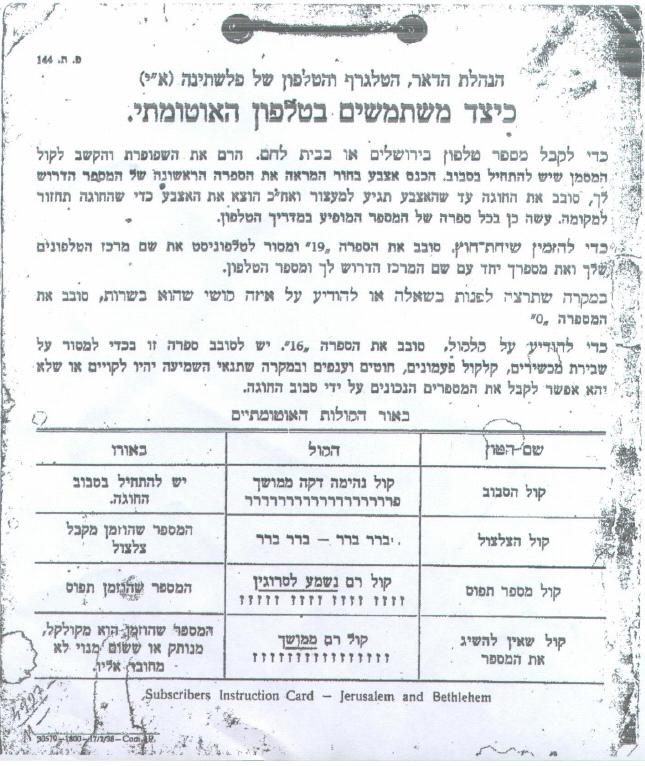

Friday, November 24, 2006
International Burial and Mourning
Disclaimer: As in all halachik discussions, what appears below is not meant as ruling, but as discussion only. Please discuss any practical applications with an orthodox rabbi.
The following halachik discussion is in memory of the ציץ אליעזר, Rav Eliezer Waldenberg, זצ"ל, and צביה צירל בת בנימין תנצב"ה. They both passed away this week. יהי זכרם לברכה.
The Shulchan Aruch (375:1) rules that normally, the shivah starts when the body is interred. In many cases, however, the deceased may be flown to Israel or some other country for burial. When does the seven day mourning period begin in this case, when some relatives accompany the body, wile some remain behind? The talmud in Moed Katan 22a states that Rava ruled that those who do not accompany the coffin, begin their mourning when they turn away their faces from the dead, and return home.
The Rosh brings down this ruling, and adds that those who accompany the deceased, begin shivah when the dead is buried. However, if there is a גדול משפחה, a head-of-family figure who generally looks after the whole family, all mourners follow his lead; if he goes with the body, everyone begins to mourn when the body is buried, and if he remains, all begin to mourn immediately. However, Tosafoth uses the head-of family strictly only. Thus, if the גדול משפחה stays behind, all begin mourning with him, out of respect. However, those that accompany the body, would count seven days only from the time the dead is placed in the ground.
The Shulchan Aruch (375:2): If a body is sent to a different country to be buried, and the mourners at home do not know when it will be buried, they begin to mourn immediately, while those who accompany the dead begin when he is buried. However, if there is a head-of-family, they all do as he does, לחומרא, similar to Tosafoth, in contrast to the Rosh.
Shach adds that this is only if the head-of-family plans to remain in the city with the dead indefinitely. However, if he plans to return to the mourners in the original locale within the seven day mourning period, even the head-of-family would mourn from the time that the stationary mourners started (i.e. from the time they turned from the dead and headed home).
The Aruch HaShulchan (375:8) infers from the language of the Shulchan Aruch that a difference in mourning times only happens when the mourners do not know when the body will be interred. However, in present times, this is almost never true, and therefore, it would seem that all would begin to mourn when the casket is buried. Even so, the Aruch HaShulchan brings many proofs that this is not true. Therefore, those staying in the original city would begin mourning earlier than those accompanying the casket, even in modern times.
The Tzitz Eliezer permits even those staying in the original town to mourn beginning at the time of the burial, if they need the time in between to sell off properties, or other things they will be forbidden to do for the seven days of mourning. He permits this based on the fact that most acharonim hold that, ideally, mourning should only begin at the burial time. Rabbi Ovadia Yosef permits this even without good reason. He also mentions that those mourners who remain behind should not practice the laws of Aninut during the intervening days, except the law not to lay tefillin on the first day.
May God destroy the concept of death forever, and may he erase tears from all faces, with the revelation of the Messiah.
Again, the above is not meant as ruling, but as discussion only. Please discuss any practical applications with an orthodox rabbi.
Thursday, November 23, 2006
Toldoth: A Wakeup call for Isaac
In this week's parasha, school children learn, Yitzchak plans to bless Esav as the continuation of the Jewish tradition. Rivkah is more astute, and sees the future of God's message in Ya'akov. She convinces her son to trick his blind, ailing father, and steal the blessings from his older brother. Students doubtless wonder: even if the trickery worked on Yitzchak, would God really allow a blessing to be stolen? Surely God would place blessing where the father intended; a blessing is not some magical oration that is oblivious to intent! And even if, somehow, the ruse would work, would Rivkah and Ya'akov, our holy fore-bearers, really manipulate a poor old man in this way? But even more fundamentally: was Yitzchak really so naiive as to believe that Esav was to continue the work of Avraham? It is clear that Ya'akov studied day and night with his father. It is inconceivable that Yitzchak would see Esav, to the exclusion of Ya'akov, as the next link in the spiritual chain.
Rabbi Hirsch, building upon earlier hints in the parasha, arrives at the startling conclusion, that Yitzchak knew very well the nature's of his twin boys. He always hoped that Ya'akov would be the spiritual inheritor. He planned, however, to have Esav join his brother as the physical and pragmatic protector of Israel. With the two patriarchs, Ya'akov and Esav, the budding nation would have all that it needed, spiritual and physical. Esav would protect the nation, while Ya'akov would temper Esav's wild streak, and subordinate it to Hashem.
It was in this that Esav was so successful in tricking his father. Esav was able to impress Yitzchak as a strong outdoorsman, but one who was controllable. He made efforts to display to his father his ability to subjugate his wild nature to his father's inheritance. Thus Yitzchak's blessing to Esav (given by trick to Ya'akov), was a blessing of physical might and wealth. The blessing meant for Ya'akov was given to him by his father later, and it is the spiritual one.
However, Rivkah saw through this 'paste board mask'. The midrash (בראשית רבה), quotes Rabbi Yehoshua ben Levi, stating that Rivkah simply wanted to make certain that Esav no longer come and deceive his own father. She saw uncontrollable wildness in her first-born, and realized the danger of this becoming part of Israel. And so, she decided to deceive her husband. She attempted to show him that if the voice of Ya'akov (קול יעקב) could deceive him into believing it was attached to the hands of Esav (ידי עשו), then how much more easily could Yitzchak have been deceived all these years into believing that the hands of Esav had redeeming qualities!
When Esav comes in and learns of the trick, his father immediately learns the lesson his wife was teaching him. He immediately confirms the physical blessing he gave Ya'akov, sealing Esav out of the Jewish nation. Later, the spiritual blessing is also passed to Ya'akov. Esav begs his father for at least some blessing, and Yitzchak utters a 'blessing' that forever pits the spiritual values of Israel in an epic struggle with the physical wildness of Edom. "You will live by your sword, and will constantly struggle to remove your brother's yoke from your neck..."
And so, the nation of Israel begins with Ya'akov, who demonstrates his leadership and physical prowess at the well, and in Lavan's house, as well as his spiritual side. It is up to his twelve sons after him to split up the qualities, while remaining true to the totality of the Jewish experience. Esav is relegated to the apocalypse, when the final battle between Godliness and Lustful living takes place.
Monday, November 20, 2006
Secular and Revelational Ethics Revisited
In the sixth chapter of Shmona P'rakim, Miamonides discusses the nature of evil urges. Does the greater person, he asks, innately desire evil, and yet to control these urges, or is it a sign of greater spiritual perfection to never be attracted to evil at all? The Rambam quotes his contemporary philosophers who hold that it is a higher spiritual level to never desire vice. While controlling latent urges is a high level, it is second to the apex of spiritual height.
Miamonides then brings Torath Kohanim on Parashat Kedoshim. There, Rabbi Shimon ben Gamliel says: "Do not say that you would not desire forbidden mixtures of milk and meat, or to wear sha'atnez, or to engage in illicit relationships. Rather, say that you desire these things, but, alas, your Father in heaven has forbidden them..." One should, says Rabbi Shimon, desire things forbidden by the Torah. It is a higher level to desire, and curb one's passions, than to never have the desire in the first place.
The Rambam makes peace between the philosophers and the midrash. As we discussed here, our ethical experience is a dialectical one, consisting of the secular, or natual, ethic, and the revelational morality. Miamonides explains that the philosophers he quoted only hold of the natural ethic. Any desire to break this system is a fundamental lacking in one's ethical being. In this case, one who is in better contact to the pulse of the natural ethic will not desire to break it. Perfect humanity would not have that desire in its consciousness. Thus, one who desires to break these ethical rules is not as high as one who never has the desire to begin with.
However, the midrash discusses revelational ethics. The Torah sets rules that may add to, or even contradict, the natural ethic. In this case, Man's tendency should be in opposition to this. Better to submit our natural morality to God's law, maintaining a constant tension between the two, than to lose our natural feeling of ethical ways. This is the higher level of righteousness.
Rabbi Rabinowitz from Mossad Harav Kook points out that the Talmud in Yoma says that forbidden relationships are something that, had the Torah not made them taboo, our natural morality would force us to forbid them. This does not contradict the midrash quoted earlier. The braitha from Yoma discusses forbidden relationships that speak to the natural ethic of humanity. It talks of incest, adultery and the like. These are, in the words of Rambam, Melachim 1:9, 'arayot bnei noach', forbidden unions that all humanity can understand. However, the midrash that Miamonides quotes discusses things like sheniyot and other forbidden unions that the natural ethic would not forbid out of hand. Thus, the two talmudic sources actually reinforce the Rambam's thesis.
Friday, November 17, 2006
Chayei Sarah: The Chosen One
There is a consistent trend throughout Genesis of the younger son trumping a first-born, and continuing the traditions of his father. We find it in Isaac/Ishmael, in Jacob/Esau, and we even find it in Judah and Joseph, to name a few. Often, the father tries to pass his authority to the first-born, and is saddened or upset by the change in plans.
Rabbi Hirsch deals with this issue, and I will add my own insights to his basic thesis. Ideally, the first-born is supposed to carry on the spiritual and physical burdens of the father. However, it is the tragedy of our unredeemed world (ever since the sin of Adam and Eve), that worthiness to care for the spiritual treasures of our nation, and practical, nationalistic prowess are not found together. Too often, he that holds the sword and shield is unwilling to submit himself to the Godly idea. And so, the two naturally mutually reinforcing strengths are split up. Ishmael takes the bow and arrow, and the physical prowess, while Isaac takes Abraham's spirit as his inheritance.
The next generation continues this paradigm, with a twist. Isaac, perhaps learning from the Ishmael story, wishes for Jacob and Esau to be co-progenitors of the Jewish nation. Esau can take care of the physical preservation of Israel, while Jacob preserve the spirit. Both would draw opposing strengths from the other. However, Esau proves to be wholly unfit, and refuses to subjugate his sword to Jacob's soul. Again the powerful first-born goes off on his own, and Jacob is left alone.
But Jacob is also Israel. He is no weakling. He is complex, and he brings forth 12 different expressions of authentic Judaism. And yet, again, both physical and spiritual destinies are taken away from the first-born, Ruben, and are split up. The Jewish manifestation of strength and rulership in the secular world is given to Joseph, and Levi is given the mantle of the spirit. Judah waits on the sidelines for the two concepts to merge. When they merge briefly in the time of David and Solomon, they are both subsumed in him. Afterwards, Judah maintains the spirit, while the physical returns to Joseph.
And so it continues, throughout history. Those who are fit to protect and develop a nation of Israel, are less than fit for the spiritual destiny. And those who carry on the spiritual and religious ideas of Israel, cannot develop appropriate ways to deal with the interface of spirit and physical world.
Until the footsteps of the Messiah. As we discussed last year, Rav Kook sees the unification of the Judah side with the Joseph side as a basic necessity for the generation of the redemption. Messsiah son of Judah and Messiah of Joseph must merge into a harmonious synthesis of spirit and national strength.
And so these torah portions are a reminder to us. Every year, we must internalize the lesson of synthesis and unification. May we soon merit to see this unification, when the ideal of spirit will intertwine with the idea of national strength. Through this, we will merit the final redemption.
Wednesday, November 15, 2006
Rambam and Intellectual Honesty
In his introduction to Sh'mona P'rakim, Miamonides says that he will quote many different philosophers in his essay, even some who not Torah oriented, or even Jewish. This does not bother him, as 'we accept the truth from wherever it comes'.
However, he says, he will not quote these sources by name, partly because there are many who would see the names, and assume that if the quote comes from a non-Torah person, it must be tainted, containing no 'good' in it at all. Thus, Rambam leaves the names out, hoping that the statements will speak for themselves. (Rambam's student, R' Ibn Palkira, states this even more clearly: 'We examine not the speaker, but what he says.')
During a discussion at Mishmar, I mentioned this Rambam. Some took issue with my unqualified acceptance of this lesson.
We must remember that God's seal is Truth. If something is true, it does not matter from where it comes. It must be accepted. This principle of the Rambam was used by many commentators throughout Jewish exegesis and halacha. In all aspects of life, but especially in the pedagogic arena, this idea must be embraced. It stresses the importance of intellectual honesty and truth over dogma. It is the difference between education and indoctrination.
Tuesday, November 14, 2006
Iran and the End of Days
The Talmud in Yoma 10a brings a discussion about the major players in the armageddon. Persia (modern day Iran?) and Edom (today's western world?) will come into conflict. Rav holds that Persia will be defeated by Edom, while Rabbi Yehuda argues, saying that Edom will fall before Persia.
I usually recoil from the urge to interpret current events as fulfillments of individual prophecies. The reason for this is that as we travel the timeline, our view is often disrupted by bumps in the road, which, without a wider perspective, can seem like mountains. We may consider certain things of paramount importance, when in reality, they are insignificant. Conversely, we often will ignore small facts that end up playing a major role in the progress of history. There are some notable exceptions to this rule, but not many.
That said, I cannot read the passage quoted above from Yoma without thinking of what the terrorist Mahmoud Ahmadinejad, leader of Iran (also known as Persia, even today), recently announced. He is gloating about his country's soon to be limitless nuclear capability. With the western world tied up in the UN security council, this man has indeed made the US and its allies look impotent. He certainly makes no secret of his desire to see Israel wiped off the face of the globe. How much more apocalyptic can this situation get? How long will it take the world to realize that, whether or not this is the looming armageddon, we must deal decisively with this murderous tyrant, lest we allow another holocaust?
Yet, we have long ceased to expect action and bravery from the UN. We are losing our faith in the US, as well. And this gives me hope.
In Ezekiel (29:6), God punishes Egypt for being a staff for Israel to rely on. Ibn Ezra understands this as a punishment for being there for Israel to rely on to the exclusion of God. When Israel has no other to turn to for protection, we are forced to turn to God. Only by engaging Him can we unlock the power that lies within ourselves as a nation, the People of God. And only then, can we meet our enemies with faith, pride and courage, confident in the justness of our cause.
Is the present situation leading up to the vision of the Talmud in Yoma? I do not know. However, it can serve to jar us into action. May we merit and elect leaders who know this, and may our nation vanquish those who rise against her.
Thursday, November 09, 2006
Ethics, the Divine, and Parashat Vayera
Every Rosh Hashana, Parashat Vayera is the first to bring us into contact with the disconcerting possibility that divine commands may clash with accepted moral norms. Abraham's willingness to sacrifice his son at God's command can be unsettling. It opens the door to questions regarding the obliteration of Amalek, various death penalties, and other examples of apparent immoral behavior required of halacha. These questions are vast, as are the works that respond to them. I add my views to them. The present analysis is inspired by Rabbi Carmy's Pluralism and the Category of the Ethical (Tradition, 30:4, Summer 1996). While the key element is taken from Rabbi Carmy's writing, the subsequent analysis is mine, and thus, any complaints or comments should be aimed in my direction.
Rabbi Carmy, influenced by R. Soloveitchik, presents Man as possessor of a dialectical moral consciousness. The first is the natural consciousness. This includes what may be considered the secular ethical drive. This is representative of Man approaching God, the Infinite. The second is the revelational consciousness. This is indicative of God nearing, as it were, mankind, and creating a bridge for humanity to traverse the abyss towards the infinite. It is the law which defines the way we are to interface with the Divine.
While the ethical norms of secular morality have inherent importance and meaning, they are a subset, or at least subordinate to, the revelational. Without the nomian structure, ethics become elastic, and may conform to the vagaries of society in general. Nothing remains absolute, and even the most obvious immoralities can evolve into neutral, or even desirable, actions. Without halachik or legal definition, terms can be nudged slightly in meaning, thus permitting or forbidding new things.
For example, most societies consider murder to be an thoroughly immoral action. However, though murder may always be wrong naturally, it takes the legal structure of revelation to define it and set its boundaries. Without that, the sliding scale can conveniently be placed at a position that permits any killing that a society desires. To wit, Nazi Germany slid the definition of murder to exclude Jews and other undesirables, redefining their termination as killing. This removed the moral stigma, and allowed the murder millions with almost no visible moral interference.
The ethical is incomplete, or at least insufficient, regarding telling us how to act at any specific time. It must either be trumped by God's revealed will, or at least subsumed in it, in order to be able to define a consistent frame of reference for right and wrong, good and evil. Thus, it is understandable that there will be situations where the revelational consciousness will require actions that the secular ethic will consider abhorrent. In these situations, the ethical is either overruled, or redefined, by the revelation. So, the ethical choice may not be the right one, and the right action may end up, in a vacuum containing only contemporary secular ethics, seeming wrong. Abraham's willingness to offer up his son is a result of his consideration of the revelational as trumping the ethical.
An important side-note is that some possible unethical things are permitted by the law, but not required. For example, slavery, polygamy, eshet yefat to'ar, among others, may be permitted de jure, while they cause the natural, secular ethic to rise up in revulsion. These may be explained as situations where the ethic is really defined through a social-cultural perspective. As citizens of our times, we fulfill our natural ethic by not participating in these actions, and they do not exemplify a clash of the natural and revelational consciousnesses. (I point out that the view in this paragraph is not held in agreement by all streams of Jewish philosophy. See, for example, Rav Kook's views on slavery. However, this concept of an ethical standard that is not built into the Torah, but develops afterwards, as a sign of cultural and societal spiritual growth is already found in Rambam's Guide, where he says, "It is impossible to go suddenly from one extreme to the other. It is therefore, according to the nature of man, impossible for him suddenly to discontinue everything to which he has been accustomed...I do not say this because I believe that it is difficult for G-d to change the nature of every individual person. On the contrary, it is possible and it is in His power . . . but it has never been His will to do it, and it never will be. If it were part of His will to change the nature of any person, the mission of the prophets and the giving of the Torah would have been superfluous. " On July 12, 2011, I was heartened and proud to see that my point in this paragraph is also made by R Eliezer Berkovits, in his distinction between Torah-tolerated and Torah-taught ethical rules.)
The Talmud (Yoma 22b) tells of Saul's attempt to present an ethical argument against the total annihilation of Amalek. He uses his natural consciousness, and finds his charge to be repulsive. A heavenly voice emanates from on high, proclaiming, "Do not be overly righteous...(Eccl. 7)" We cannot be more righteous than God. This is the revelational consciousness, which asserts itself over the natural ethic. When our understanding is contradicted by the Divine Infinite, which we, as finite beings, cannot fathom, there is no choice but to retreat.
(27 Kislev, 5769: Revisiting this issue, my chevrusa and I discussed the ethical in light of the Torah. Our discussion concluded that perhaps an individual halacha, such as Amalek could not be used in isolation to teach the ethics of the Torah, for it is a product not of a purely ethical form or category, but a result of various competing ethics and considerations. For example, the act of torture may be morally reprehensible. However, when used to urge a terrorist to reveal the location of a ticking time bomb, the overall ethical thing to do is to use torture. Some actions should define us (being kind, being peaceful), and are inherently ethical, while other actions, though sometimes employed, do not define our ethic, and only receive the nod of approval because of surrounding considerations. Thus, while an individual halacha may not define morality, the totality of halachot and hashkafa do, and provide a framework and set of rules to, with all the complexities of life, choose the best possible course of action when none may always be perfect. אשת יפת תואר and עמלק are thus not necessarily so different. They are both the best course of action for imperfect situations.)
Tuesday, November 07, 2006
Vayera: Spiritual Purpose in this World
Here is a speech I co-wrote with a student for his Bar Mitzvah:
Of all the important events that take place in our parsha, Vayera, two raise some interesting questions. The first is Avraham’s recuperation from the Brit Milah, and the second is the ultimate test of his obedience to G-d, the Akeida.
At the beginning of the parsha, we find Avraham recovering from his Brit Milah. At the command of G-d, he has undergone a painful procedure that sets him apart and distinguishes him from other people. He has reached a new spiritual high, and has become the first Jew. And where do we find Avraham, shortly after his brit? Sitting at his own doorstep, hoping, searching for guests to invite in. The talmud in tractate Bava Metzia says that Hashem made the weather extra hot that day, so that no travelers would be out. G-d wanted Avraham to have a rest, without strangers to entertain. However, when G-d saw Avraham distressed over his lack of guests, he sent angels to him in the form of men.
Why does Avraham so desperately want guests right after his Brit Milah? Also, Rashi tells us that G-d himself had already come to visit Avraham in his weakened state, even before He sent angels. Why does Avraham leave G-d’s presence in order to tend to three travelers? Let’s leave that question for now, and turn to the akeida.
At the end of our parsha, Hashem orders Avraham to bring his son, Yitzchak, as an offering. He and his son travel to Har Hamoriya with two servants. Father and son are equally intent on fulfilling G-d’s Will. They take leave of the two servants at the foot of the mountain, and ascend to the top. The Torah uses the phrase ‘vayelchu sheneihem yachdav’, ‘they both continued together’ in two verses. According to Rabbi Hirsch, the term ‘yachdav’, ‘together’, is used twice, to emphasize the complete harmony and unity of father and son, in their intention to do Hashem’s Will. Of course, G-d never really intended for the sacrifice to actually take place, and Avraham and Yitzchak soon return to their servants and make their way home.
Here is the pasuk that describes their return home: ‘vayashov avraham el ne’arav, vayakumu vayelchu yachdav el be’er sheva’. ‘Avraham returned to his servants, and they all went together to Be’er Sheva’. Interestingly, the word ‘yachdav’ is used again. This time it describes Avraham and Yitzchak walking together with their servants.
The word ‘together’ is used to describe Avraham and Yitzchak’s path towards the most intense spiritual experience of their lives. Why is it used again later, regarding the seemingly mundane walk back home with their servants? Also, the paragraph of the Akeida episode ends in a strange place. I would have expected it to end with G-d blessing Avraham and Yitchak for their faithfulness. Instead, the Akeida narrative adds the pasuk describing the walk back with the servants. This pasuk is tagged on, making it part of the Akeida narrative. Why is the trip home with the servants part of the lofty akeida story?
Rabbi Samson Rafael Hirsch offers an interesting explanation to both these episodes:
Other religions hold that spirituality in this world consists primarily of breaking all ties with the physical world and its inhabitants. The person who gets closest to G-d is the one who retreats from the pleasures of this world and escapes from interaction with other people. He meditates for hours at a time, and becomes reclusive. This person often does not marry, have children, or even live among other people.
This type of spirituality is not the ideal in Judaism. As Jews, our job is to connect to this world, and bring it closer to the goals that G-d set out for it. We are also meant to enjoy this world fully, according to the commands, and within the bounds of the Torah. Sometimes, in order to regain proper mastery over our urges, we temporarily deny ourselves permitted pleasures. For example, when a Jew becomes a nazir, he foregoes drinking wine for 30 days. But at the end of that period, he must bring a sin-offering. Rambam writes that this sin-offering is brought to atone for his abstinence from wine, a legitimate pleasure that G-d permits.
As Jewish people, when we have a spiritual connection to G-d, we are not supposed to become hermits. G-d wants us to use our spiritual growth to develop relationships with others, and bring them closer to G-d, as well.
This same lesson is taught at our parsha’s opening. Why did Avraham so eagerly seek out travelers right after his circumcison?- And why did he feel that offering others hospitality was even more important than talking to G-d? After Avraham’s brit, he was afraid that his newfound spirituality might be a barrier between him and others. He felt this especially, since he had physically altered his body, and differentiated himself from the rest of the world. It is precisely at this time that Avraham felt the need to invite strangers. He wanted to demonstrate to himself and to the whole world, that even though he is different, he is not apart from them. Indeed, Avraham sought to reaffirm his ties to humanity.
The same thing happens in the story of the akeida. Avraham and Yitzchak reach the height of spirituality, of mesirat nefesh. Although the climactic spiritual experience is reserved exclusively for Abraham and the son who G-d chose, they do not let it make them arrogant. They do not in any way look down at their servants afterward. On the contrary, they walk together with their servants, ‘yachdav’, as they walked together as father and son when they had to be alone.
The lesson is clear. Jews do not become closer to G-d in order to separate from Mankind, but to help them, and to bring godliness down to Earth. It is our job to bring that holiness into this world.
Saturday, November 04, 2006
Of the National-Divine
In his essay, "Concerning the Process of Ideas in Israel", Rav Avraham Yitzchak Kook presents a holistic approach to Jewish national history. The following is an insufficient summary; the interested reader is enthusiastically directed towards the English translation (in the collected historical essays of Rav Kook, When God Becomes History, B. Naor, ed. Orot, Inc. 2003, pp. 66-88).
Rav Kook begins with the thesis that there are two components to Jewish life: the National idea, and the Divine idea. The National idea is that pride and courage which propels a collection of humans to create a society. It includes the concept of State, but goes beyond that. The Divine idea, on the other hand, is the spirit which moves Man to engage the Infinite. It gives joy and vitalizes the Jewish nation, provides meaning to life, and acts as a light unto the nations. It is the presence of shekhinah within the nation.
These two concepts are completely interdependent. The spirit of the Divine imbues the National with meaning and height, while the National provides bravery, esprit de corps and a proper vessel for the nation's mission. The Jews in the times of Solomon experienced this celestial interaction.
However, even when the nation as a whole dwelled in the Divine idea, individuals engaged in idolatry and other spiritual poisons, to which the surrounding nations lured them. The Divine light was pushed out of individual souls, and unleashed the beast inside. The Divine idea began to rot from within, until all that was left was the National idea. This became so divorced from Godliness, that it became more like the nationalism demonstrated by other nations, and it eventually fell apart. However, as hard as it was to see, the Divine spark rested, deep in the recesses of the nation's psyche, waiting to re-emerge.
In the exile, the National idea was gone. All that was left was for the exiles to pick up the pieces of their Divine spark. However, without the National bond, and with the Jews dispersed and no longer rightly a nation, the individualistic tendencies of this spirituality came to the forefront. The Jew became obsessed with individual salvation and guarantee of personal immortality. The minutiae of law and custom replaced the joy of national experience. This is when the World to Come became such an important concept. Earlier, the Divine light completely outshone these concerns, and a person found natural immortality through his membership in Knesset Yisrael. Now, however, the Divine idea gave way to the new Religious idea, one which focused on the negative, rather than the positive. Both always existed, but the focus had shifted.
Originally, the pagan cultures of the world were to see Israel in its glory, and be influenced by the interaction between the National and Divine ideas. However, it was tragically the exile, when the Religious idea was in force, that the nations chose to learn from. Thus, Islam and (especially) Christianity took the negative, the obsession with the individual, and the preoccupation with the afterlife. (Rav Kook's son discusses how scientific skepticism begins to chip away at this unhealthy lesson taken from Judaism, and paves the way for the nations to ultimately rejoin the correct path, when Israel is ready to provide the correct example.) However, the dispersion also had beneficent results, in the Divine idea being spread, in some form, to the whole world.
Ultimately, however, the Divine spark keeps pressing the Jewish nation to change its ways. Repentance is a long process, but involves the re-emergence of the National idea, once again. The Divine idea aids this National idea and refines it. The Religious idea is once again subsumed in the Divine and National interaction, with the understanding that the minutiae of the Law aids, not only the individual, but, most importantly, the nation as a whole. Thus, the individual gains his importance and value through the nation once again.
This essay is as important today (if not more) as it was eighty years ago. I would only add that we must not lose hope when we see the National idea struggling to keep the Divine idea away. These cosmic changes take time, and faith in God's plan must guide us. Let us recall Rav Yosef, who said, "Let the Messiah come, and may I merit to sit in the shadow of the dung of his donkey." Unlike the other sages, Rav Yosef understood that the negative manifestations of physical and National rebirth would eventually give way to the light of Torah and the knowledge of God.
To quote Rav Kook, "Rav Yosef will light the candle of the commandment, ...and a little light dispels much darkness. The evil will be transformed into good, the curse into blessing. This is the import of the cryptic passage of the Zohar:
- The head of the academy in the palace of Messiah said, 'Whoever does not transform darkness to light and bitterness to sweetness, may not enter here.'
Friday, November 03, 2006
Zecher Lachurban
Disclaimer: As in all halachik discussions, what appears below is not meant as ruling, but as discussion only. Please discuss any practical applications with an orthodox rabbi.
The Tur (Orach Chaim 560:1) and Rambam quote a passage from Ta'anit which states that as a reminder of the destruction of the Temple, Jews do not finish the sid (whitewash, or white finish on the walls of a house) completely in their houses, rather, they leave an amah square (about 50 cm2 ) unfinished. The ideal placement is opposite the front door, so that it is visible to those who enter the house. However, if no place there is available, one may place this above the front door.
The Shulchan Aruch (ad. loc.) codifies this minhag and further states that if one buys a house finished, one does not have to scrape away part of the wall finishing for this purpose.
The Taz holds that the reason for this minhag is that members of high society would buid a house completely out of this sid. This thicker, more durable sid should not be the sole building material for a Jewish home, so that we remember that we do not have perfect comfort and luxury without the Beit Hamikdash. However, one may build a house of plaster or concrete, and then cover it with sid. In order to make it clear that the house is not completely made of sid, we leave an amah square of space that shows the true building material of the house.
The Levush, on the other hand, holds that the amah squared must lack even plaster, and must be a space that leaves the house unfinished. The amah squared is not simply a way to show everyone that the house is not completely sid, rather, the amah is there to lend an aura of incompleteness to the home.
Based on this Levush, the Arugot Habosem says that, nowadays, since we paint and have other finishes in our home, we can finish the whitewashing completely, and leave a space of an amah square unpainted, or otherwise finished. He mentions, however, that this leads to a more strict ruling in the case when one buys a finished home. One who wishes to paint the house must leave an amah square unpainted, even if this was not done originally when the house was built.
Rav Moshe Feinstein has a teshuva (OC 3:86) in which it seems he agrees with the Arugot Habosem, and sees the amah as a heker, to make sure we constantly remember the Beit Hamikdash and the destruction. Rav Moshe joins many acharonim, including the Mishna Berurah, in defending (being melamed zechut on) the fact that most people do not keep this minhag anymore, particularly in the diaspora.
(By the way, an acharon (I forget who) suggests the possibility that this halacha does not apply to people who live in Jerusalem, as they are constantly confronted with the destruction, and need no extra reminder. I think this is a big chiddush, and have not seen anyone else agree.)
May we merit the rebuilding of the Temple speedily, and may our national home, Eretz Yisrael, and individual homes, be complete.
Again, the above is not meant as ruling, but as discussion only. Please discuss any practical applications with an orthodox rabbi.
Wednesday, November 01, 2006
Lech Lecha: "And he Called Up his Troops"
When Lot was kidnapped by the alliance of four Kings, Abram was dragged into a battle he would have liked to side-step. He realized that even with all his students (ignoring the midrash that he went to battle with only his trusted servant by his side), he was, most probably, laying down his life. In fact, the midrash plays on the word, 'vayarek', by saying it means 'he greened their faces,' by ordering them into a battle they could not expect to win.
Abram did not feel assured of victory because of his relationship with the Almighty. He realized that his life was to be used in God's service, and if that meant death, then so be it. In short, he had no illusions that doing the right thing would automatically lead to short-term positive results.
This is a lesson that is deceptively simple to learn. So many stories, from midrash down to Hassidic tale, engrain in our minds from a young age that, if we do what God wants, he will immediately make everything work out to our benefit.
The lessons of these stories must be made clear to children, that it is not in the short-term that good will necessarily lead to positive results, but in the long-term, larger picture, that it will. If we expect immmediate reward, we set ourselves up for disappointment, failure, and, Heaven forbid, rejection of the concepts of reward and punishment.